
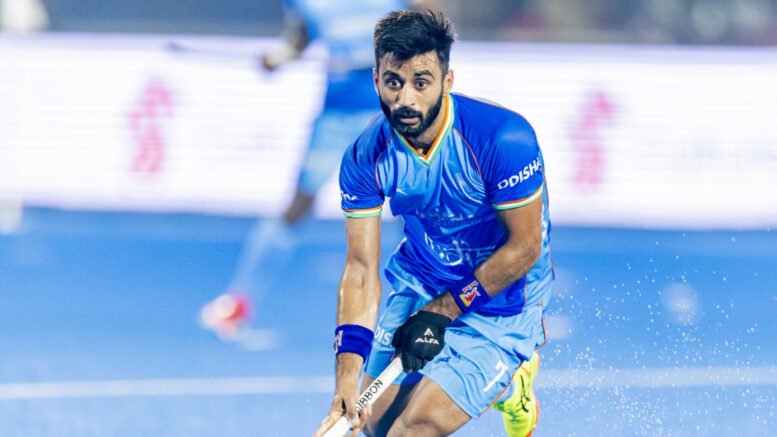
When India finished last at the 2012 London Olympics, Manpreet Singh was a teenager still trying to establish himself in international hockey.
Fourteen years later, on Wednesday, when he took the field against Germany in Rotterdam for his 413th international appearance, becoming the most-capped player in the history of Indian hockey by overtaking Dilip Tirkey, he was one of the last remaining links to that team.

Between those two moments lies perhaps the most turbulent and transformative period in Indian hockey history. India have gone from humiliation to Olympic medals, from rebuilding to resurgence. Coaches have come and gone, tactical systems have evolved, and entire generations of players have passed through the national setup.
Through all of it, Manpreet remained. That is what makes the milestone remarkable.
In Indian hockey, a single year can feel like a lifetime. It is a sport governed by brutal physical demands, relentless competition for places and an administrative ecosystem that has rarely been known for patience. Players are often only a poor tournament, an injury or a coaching change away from losing their place. Longevity is rare. Lasting 15 years at the highest level is almost unheard of.
It’s something Hardik Singh, the veteran forward, keeps alluding to. When Manpreet made his debut, Hardik was still a schoolboy watching him on TV. The two, on Wednesday, shared the same midfield that sliced open Germany in the FIH Pro League. India won 3-1 in a rare dominant performance this season. Manpreet didn’t score, but he was there doing what he does best – adding heft to the attack and solidity to the back line.
What has allowed Manpreet to endure where so many others have faded is his willingness to constantly reinvent himself. (Hockey india)
What has allowed Manpreet to endure where so many others have faded is his willingness to constantly reinvent himself.
The midfielder who burst onto the scene was defined by relentless energy. He seemed capable of covering every blade of grass on the field, pressing opponents, carrying the ball forward and appearing in both circles within moments. Like many athletes of his generation, there was an emphasis on physicality and the visible markers of fitness that dominated sporting conversations a decade ago.
But modern hockey does not reward nostalgia.
Following the Paris Olympics, Manpreet recognised that remaining the same would mean falling behind. At 33, he undertook yet another transformation. He shed significant weight, altered his training routines and shifted his focus towards agility, endurance and recovery. The objective was not simply to remain fit; it was to remain relevant.
The change has extended beyond his physical conditioning.
As age inevitably takes away a fraction of pace and explosiveness, Manpreet has evolved into a different kind of midfielder. The all-action runner has become a deeper, more measured presence. He now controls tempo, occupies intelligent spaces and dictates play with experience as much as athleticism.
It is an evolution that has impressed even the younger generation. Hardik Singh, now one of the leaders of the Indian team, belongs to a group that grew up watching Manpreet. Today, he speaks openly about admiring the veteran’s ability to keep pace with players nearly a decade younger.
Yet the journey to the record was not entirely straightforward. Earlier this year, Manpreet’s omission from the national camp briefly raised questions about whether he would get the opportunity to surpass Tirkey’s long-standing mark. For a player who has spent much of his career navigating the uncertainties that define Indian hockey, it was another reminder that longevity is never guaranteed.
He returned, reclaimed his place and eventually moved clear at the top. Perhaps that is the most fitting way for the record to have arrived.
In Indian hockey, surviving one cycle is difficult. Manpreet Singh has survived four.


Be the first to comment on "HIL: How reinvention made Manpreet Singh India’s most-capped hockey player"